Showing posts with label project. Show all posts

Tuesday, May 17, 2011

C# and .NET interview Question - Have you used crystal report in your project? If yes, then how?

Answer:
Any project you take in .NET or any language reporting is an integral part of the application. You will rarely find application without reports. Due to heavy usage of reporting in application this topic becomes a hot favorite of interviewers. There are two prominent technologies by which you create reports in .NET one is crystal reports and the other is SQL reporting services. In this question we will try to answer from the crystal report point of view.

So again a very typical .Net interview question which is asked to understand if you know how to create crystal report.

Let’s demonstrate a simple example to see that, how we can create crystal report
in our project.


Creation of crystal reports its basically 7 step process as following.

Step 1:-This is very simple and basic step for adding crystal report in the
project for that just click on the "Project" menu and select "Add New Item" -->
"Reporting"--> "Crystal Report".
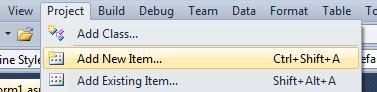


Step 2:-When you click on add button the following window will appear and you
can select your choices according to your project requirement and then click OK.


Step 3:-As soon as you click on OK button a new window will appear from that
expand Create New Connection ->OLEDB(ADO) as you can see in below diagram.


Step 4:-Now, Expand the OLEDB(ADO) folder and a new window will appear with all
the connection providers from that you can select your own connection provider
name and click on “Next”.


Step 5:-When you click on Next a new window will pop-up where you can define
your server name and your database name then click on Next another window will
pop-up then click on “Finish” later you can see a new window like below diagram
with your selected database then you can select the table on which you want to
generate report and click on “Next”.


Step 6:-Choose the field name, which you want to display on your report and
click on “Finish”.


Step 7:-Once you have completed the above step then create a new form and place
a CrystalReportViewer from the toolbox and define the report source like below
diagram.


Once you select the report source click on “OK”, now you can run your project
and see the report.


Please click here to see more c# and Dotnet interview questions

Regards,

Visit Authors blog for more Most asked c# interview questions

Friday, March 25, 2011

Design pattern interview questions :- Which design patterns have you used in your project ?

Answer:

First thing what ever you say , for heaven sake do not say we had used all design patterns ;-) . Look at your project and see which design pattern have you used. Almost all projects use design patterns knowingly or unknowingly , until the project is complete disorganized.

While explaining do ensure to make a 1 line comment atleast to say why that design pattern was used.

Below goes a decent answer of explaining things collectively. Please note answer will change as per your project implementation.

In my current project we had used MVC, Singleton, factory , iterator and template pattern.

My project was tier architecture, divided in to 3 main sections, UI, Business layer and data access layer.

At the presentation level we had used MVC pattern, so the UI and model was separated using controller class.

To share common data across all tiers we had used the singleton pattern.

Factory classes where used between each layer for decoupling and centralizing object creation to avoid code complication.

Iterator pattern was used to browse through middle tier objects thus providing a tight encapsulation.

The middle tier objects and their child objects where standardized using template pattern for consistent vocabulary and naming convention for business objects.

Watch the below design pattern video which explains factory pattern.


Regards,

Please click here to see .NET interview questions and J2EE design pattern questions

Thursday, March 17, 2011

.NET Interview questions :- How did you do unit testing in your project?

Answer:

In today’s software industry people do not just look how good you are in coding but they would like to know how good you are in processes.
This C# interview question touches one of the important aspects of SDLC processes which is “Unit testing” or you can say white box testing.

Note: - Many developers answer that they did unit testing manually. Many interviewers of bigger companies will not be pleased with this answer. The whole point about unit testing is to automate white box testing. The time you say you have done manual testing which means you have done integration testing.

There are two important testing tools which are widely used to do unit test in Microsoft technologies, first is VSTS Unit test and second is NUNIT.So if you have used one of these tools, do talk about the same. Below is a simple sample answer by a developer who has used VSTS unit test for testing.

“Our project was divided in three layers UI, BO and Data access layer. Asa developer I was responsible to write unit test code on the middle layer or the business object. We used VSTS unit test suite to write our test. So for each important functions and methods of the middle layer stubs where generated by right clicking on the middle layer functions. Inside the stub we went and put proper assert function as needed by the test”.

View my 21 important .NET Interview questions and answers

Monday, March 7, 2011

.NET interview questions :- Can you explain architecture of your project ?

.NET interview questions :- Can you explain architecture of your project ?


Answer:


This is normally the first .NET interview question which pops up in .NET and C# interviews. Personally i think your full .NET interview ahead depends on how you will answer this question.

Common mistakes :- Many developers make a common mistake of answering this question by saying that we have used C# , SQL server , ASP.NET etc. But please do note that the question is, what is the architecture of your project and not technology.

So a typical answer will be something as below. Please note your answer will vary as per your architecture and structure.

"My current architecture is a simple 3 tier architecture with UI in ASP.NET , middle layer are simple .NET classes and DAL is using enterprise application blocks.
The UI is responsible to take user inputs , all my business validations are centrally located in middle layer and the data access layer is responsible to execute stored procedured and SQL queries to SQL Server.

Strongly typed business objects are used to pass data from one layer to other layer. The database of the project is in a 3rd normal form."

So first start with the overall architecture , talk about each layer , how data is passed between each layer and the database design structure.

One very important tip if you can draw a diagram and explain....I think you have the job.


Thursday, March 3, 2011

.NET Interview question :- What coding standards did you followed your projects ?

.NET Interview question :- What coding standards did you followed your projects ?


Answer:
This is a very general .NET interview question.

Normally properly planned companies have a checklist of what kind of naming convention to follow. In .NET interview its very difficult to speak about the whole checklist as we have limited time.

The expectation of the interviewer is that you should speak about pascal,camel and hungarian naming conventions and where did you use what. So below goes a short answer.
Our organization had a naming convention document which was supposed to be followed by all projects in the organization. As per the document we where using three types of naming conventions across the project :- Pascal , Camel and Hungarian.
All class names , function names , method names , namespace names where using pascal convention. i.e. the first letter capital with every first word capital.ex CustomerCode
All variables , input/output variable , local variables , class level variable , global variables where using Camel notation. i.e. the first letter small and then the first letter of the subsequent words capital.ex count , customerData
For the UI object we where using hungarian notation. In this the prefix defines the datatypes i.e. txtCode , cmbCountries.
For database we used Hungarian notation where the prefix defines the data base object types. i.e. tblCustomer , uspSelectCustomer,fngetValue,trgInsert.
Regards,

Check out my 22 top .NET interview questions and answers

Monday, February 28, 2011

C# Interview questions:- What role did your play in your current project?

C# Interview questions:- What role did your play in your current project?


Answer:
This is again a great c# interview question , but .NET professionals tend to answer this
question in one liners like i am a developer , project manager.

In todays world people expect professionals who can do multitasking. The best way to approach the answer is by explaining what things did you do in the complete SDLC cycle. Below goes my version of the answer , you can tailor the same as per your needs.
My main role in the project was coding , unit testing and bug fixing. Said and done that i was involved in all phases of the project.

I worked with the business analyst in the requirement phase to gather requirements and was a active member in writing use cases.

I also assisted the technical architect in design phase. In design phase i helped the architect in proof of concept and putting down the technical design document.

My main role was in coding phase where i executed project with proper unit testing.

In system integration test and UAT i was actively involved in bug fixing.
Other than the project i help COE team for any kind of RND and POC work.
In case you are doing some extra activities in the company like helping COE , presales team or any other initiative do speak about the same.

Watch my 50 C# interview questions and answers

Monday, November 12, 2007

My Best and the worst Project i worked with...

My best project till now. .NEt and SQL Server Interview questions. Wanted to write a book which will take me in to every microsoft professionals heart.....It was 3 months of continous writing....I think i have made it where i wanted to.

This was in my young times , working in DELL. Great project its still working running around 280 locations and a has ahuge financial turnover. Was looking after a team 6 people was a team lead...... There was a time when the head of department technicals gave up saying that the dead line is impossible. 6 members and me made to the top. Received the best team award.

Ebenshoppe team of around 15 people....The project failed but is still my best project for the only thing the decision of marketing was wrong and not technical......Will not forget those struggling days.

10 books launch. This was not a project actually i mean not a software project. Had promised to one of my publishers for delivery of 10 books. I mean write 10 books. lot of people left me alone. Tied up with one local guy completed it. Saved publisher and his money...not to forget lot of book shopkeepers where also waiting for the same.


VFS where i am working currently. Good team to work with. The speciality of this project it was not something short like normal project but rather a huff and tuff one year continious development project....Happy with it , my main goal of entering this project was to make one common project....i think we did it......

Whats next.....

Sunday, March 18, 2007

Points to be noted while working in projects

Started my C# and ASP.NET projects book. Below are some text from the same


There is life outside projects....your life and your family.Love your work but not your project or the company. Many developers after a certain amount of time become possessive about the project and the company. Try to come on time and go on time. So that you do not get saturated and work on the project for a longer time and effectively.

Try to freeze your requirements before the start of the project. In practical scenarios it is very difficult to control the end customer. But if you can atleast control the changes that will make the project more comfortable. The best way to control changes is by taking official sign offs from the end Customer.

Do not try be a hero in the project. Because heros also have to go through all hardships. So believe in equal load distribution which is not only good for the project but also for you on long run.

Every project has parasite developers. In short every project has developers who constantly take help from others thus bringing down productivity. Yes its is possible that those are your freinds , but remeber one thing do not give fish to the needy teach him how to fish. If you are project manager you should analyze such kind of developers and ask for replacement and if you are a developer avoid doing their work from start to finish. Yes give them hint but do not do complete coding for them.

Do not make projects your learning ground. Customer’s pay heavy for making software do not make it a learning ground. In many projects developers try to implement new technologies in mid of the project just by hearing jargons.

Test, Test and Test. That’s the key to success for any software project.

Do not hide your defects. Developers are the best guys who know where the code will crash. Do not hide it , analyze and fix it. Do not cheat and leave the same till it goes to the end client.
Avoid ego issues during project. Many times in project developers and managers get stuck up with ego issues. Sometimes moving back makes the project move further.

Tackle bigger problems of the project first. The best way to complete any project is to start those screens which are used by the customer more often. For instance every project has non-frequent masters code them later and start the transaction screens first. Many time developers end up doing nitty gritty work and forget the bigger part of the project.

Do not talk about stars. Every project starts with talking about stars but later end up somewhere else. Developers talk about concept of OOP’s , full database normalization , design patterns etc etc. These fundamentals are important but it should not end up with only jargons. Some times practical deadlines makes it impossible to implement these features. Keep yourself flexible and compromise with quality when you have deadlines…..believe me its not a sin if customer is giving you unreasonable deadlines.

Maintaining a right project hierarchy is very important i.e. the A model. In A model you have one senior person at the top , project manager , team leader , senior developers and then juniors. The right proportion of people from each grade is important. On any level if you have too much concentration you will have ego issue and promotion issues.

Do not treat your project people as a resource. Project managers have these jargon of thinking every one as a resource. Thats bookish thinking. Any one working in a project is finally a human with emotions. The time you consider them as resource they will consider you as resource.

Make yourself visible. If you think you have done something good show it , advertise it , make it visible. Will help you during your assesment.

Avoid getting in to project politics. Peace of mind is the most important thing. Getting in to egos and politics will only complicate things.

If you are working on maintenance project upgrade yourself time to time.

In case you are Maintaining some other Developers code do not criticize the code. Who know in what circumstances was the project made.

If you are project manager in the project do not make it a compulsory rule that you will never touch coding. Remember juniors respect their seniors if they sit with them for development and know their difficulties.

If any resource is working on a project for more than a year his performance comes down. Prepare a proper KT plan and bring in new ressources and roll the old resources off for some better propects.

Avoid unnecessary meetings.